Dominioni Lorenzo Writer
Via Giuseppe Verdi, 23
21020 Brunello (Va)
Cookie and Privacy Policy
Dominioni Lorenzo
writer

readings on art and symbols of
Dominioni Lorenzo
writer
Symbols of infinity
part 1
Symbols of infinity
part 3
Symbols of infinity
part 2
We distinguish at least three categories of infinity: mathematical, physical, and philosophical-religious. In many works of art the key to interpretation lies in the geometric, phyto-zoomorphic and religious symbols used to depict infinity.
Human beings have an innate tension toward the infinite, the desire to overcome every limit, the yearning for the transcendent and, in the religious sphere, the aspiration to eternal life. Particular signs, images and colors have been used in the history of art to symbolically represent the various aspects of the concept of infinity.
Life unfolds under the sign of finitude, but we must also come to terms with the infinite, with the transcendent and with the difficulty of defining them. From this follows the need to imagine and to describe the infinite through symbols, images that express an "other" by evoking the infinite.
The signatures of medieval artists - part 2
Narcissus in art
The signatures of medieval artists - part 1
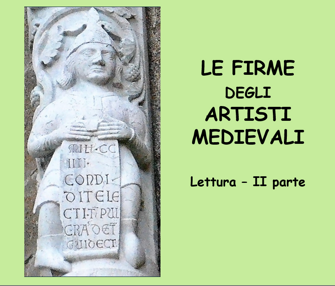
From the 12th century onward, especially during the Renaissance, the engraved signatures on works sculpted by the most famous artists are accompanied by self-celebratory phrases, sometimes rather grandiose. These attest, beyond the author’s narcissism, an awareness of one’s own high worth.
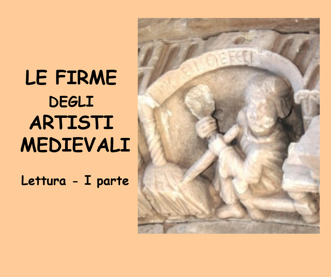
In the early Middle Ages artists' works are anonymous, except for rare cases. From the 11th century, carved signatures begin to appear on artworks, a sign of awareness of the authors' worth and a valuable source of information for art history.
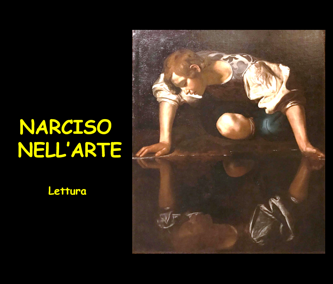
The myth of Narcissus who, in love with his own reflected image, no longer had the strength to tear himself away and died drowned, has fascinated the world of the visual arts from the Renaissance onward, as a warning against vanity, as a romantic myth and as an object of study in psychoanalysis.
Self-portraiture in painting
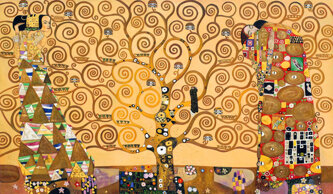
The Tree of Life in art history
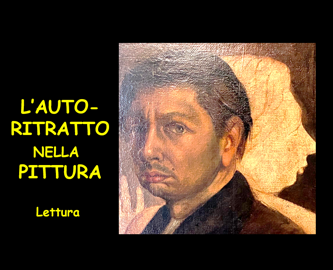
Since the end of the Middle Ages painters have never stopped painting self-portraits. Almost none of the famous artists escaped the temptation to paint themselves. Some did it many times, sometimes in the same painting.
The Tree of Life is a universal symbol of union between Heaven and Earth, between matter and spirit. The roots represent origins, the trunk vital strength, the branches expansion and growth. It expresses the harmony of the cosmos, the continuity of existence and the deep bond among living beings.
for more information