Dominioni Lorenzo Writer
Via Giuseppe Verdi, 23
21020 Brunello (Va)
Cookie and Privacy Policy
Dominioni Lorenzo
writer


essays and research on symbols in art
Dominioni Lorenzo
writer
Armenian stylistic motifs in the external sculptural decorations of the Basilica of Sant'Abondio in Como
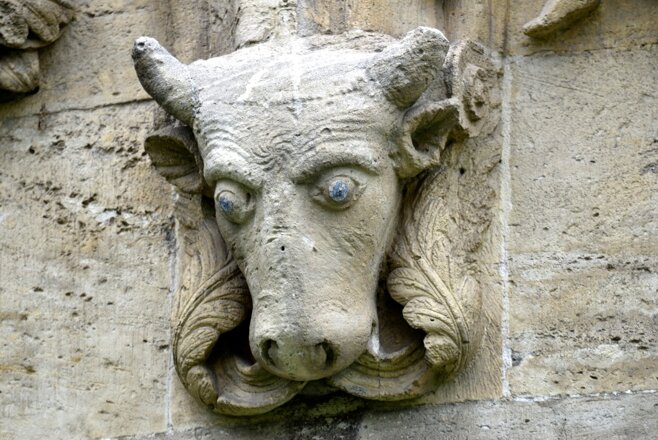
The Medieval Armenian Symbol of Eternity and the Art of the Twelfth-Century Italian Sculptor Nicholaus: A Veiled Performance
Lorenzo Dominioni* and Antranik Balian
*Hon. Professor, University of Insubria, Varese, Italy
Journal of the Society for Armenian Studies, 28 (2021) 1-21
Abstract
The medieval symbol of eternity—the vortex—is carved on the forehead of five bull heads sculpted in the first half of the twelfth century, attributable to the workshop of the Italian sculptor Nicholaus. For millennia the vortex has been an ancient sacred symbol associated with eternal life, not exclusive to any religion or culture. The bull heads bearing a geometric-looking vortex are located, respectively: on the apse frieze of the Koenigslutter Kaiserdom (Lower Saxony); in the pulpit of the Sacra of Carpi (Modena); in the panel of the “Creation of the animals” on the façade of San Zeno (Verona); in the atrium of Verona Cathedral; in the narthex of Ferrara Cathedral. The vortex, a symbol generally ignored in Western Christian art after the Carolingian age, was revisited by Nicholaus’s workshop. We believe that the small vortex, a detail so far overlooked, carved by these artists on the bull’s forehead at Koenigslutter, Carpi, Verona and Ferrara, is a veiled ornamental rendering of the concept of eternal life in the afterlife. The inspiration to depict the vortex is apparently of Armenian origin, because at the beginning of the twelfth century the vortex was a decorative element foreign to Italian religious sculpture, whereas it was firmly rooted in Armenian Christian art. Nicholaus and his atelier likely knew the foliated cross and the vortex—traditional Armenian symbols of life in the afterlife—and drew on them in some of their works. Numerous examples of the metamorphosis of the geometric vortex into a leaf vortex with a natural appearance are visible in the bas-reliefs of the façade of San Zeno, in the atrium of Verona Cathedral and on the frieze at Koenigslutter, attesting to the intention to represent in that versatile way the concept of eternal life.
Lorenzo Dominioni
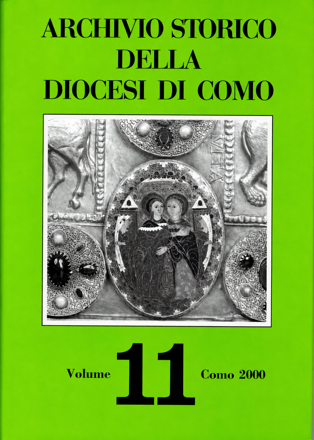
Historical Archive Diocese of Como, 11 (2000) 91-113
Abstract
Among the many 11th-century buildings erected by the stonecutters working on the sites of the ancient Diocese of Como, the basilica of S. Abondio is the one that shows the most important ornamental sculptures, both in qualitative and quantitative terms. Uncertainty still surrounds the basilica’s decorations regarding their dating, stylistic attribution, and the technical methods used to execute the bas-reliefs.
The stylistic matrix of the very extensive exterior decoration was in the past generically defined as “eastern” but has never been clearly identified. Moreover, the unfinished state of several portions of the exterior ornamentation is evident, as is the contrast between the refinement of the decoration and the almost bare linearity of the structure; this raises many questions about the style, technical approach, and chronology of the bas-reliefs’ execution.
In this regard I report some observations of mine on the stylistic features and decorative technique of the basilica’s bas-reliefs; in particular on the interlaced geometric ornament, on the phytomorphic ornament, and on miniatures as an iconographic model, which suggest the influence of Armenian art on the decorator stonecutters of the S. Abondio site.

contact me for more information